What Are the Top Types of Peeling Equipment in 2026?
In 2026, choosing peeling equipment is less about finding one universal machine and more about matching the method to the crop, throughput, and finished product. A small potato processor may value gentle handling and low product loss. A large vegetable line may need continuous operation, fast changeovers, and predictable output. Abrasive, knife, steam, and chemical peeling systems each work differently. None is automatically the best choice.
The pressure to improve efficiency is real. FAO reported that 13.2% of food was lost between harvest and retail in 2021, while UNEP’s Food Waste Index Report 2024 estimated 1.05 billion tonnes of food waste at retail, food-service, and household levels in 2022. These figures describe food loss and waste broadly; they do not measure peeling-machine performance. Still, they make yield, water use, energy demand, and usable by-product worth examining when comparing equipment. Small differences matter.
This guide reviews the leading types of peeling equipment used in food processing and explains where each may fit. It considers peel quality, product damage, capacity, sanitation, and operating costs—not just advertised speed. A machine’s results depend on the crop and process settings, too. That detail is easy to miss. Buyers should verify performance with their own products and request measurable trial data before investing.
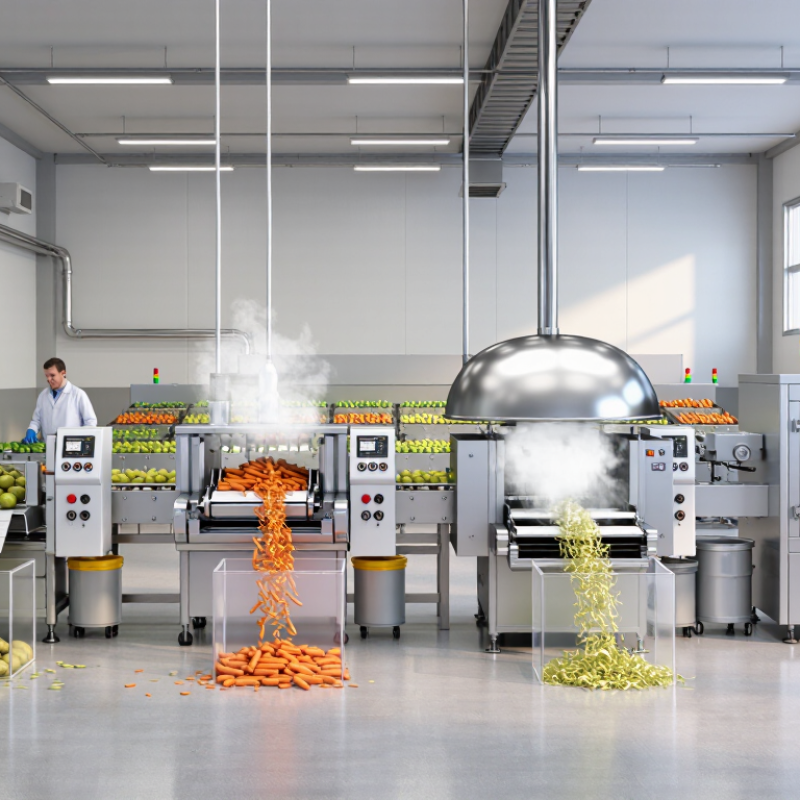
Steam Peelers: 10–20 bar Pressure and Rapid Skin Release
Steam peelers expose vegetables to pressurized steam, then release pressure rapidly. In suitable systems, pressures around 10–20 bar can loosen skins within seconds. This range is not a universal setting; the right operating conditions depend on the machine, crop, size, and batch condition.
The rapid pressure drop helps separate the skin from the flesh. Watch the discharge: skins should lift cleanly while the product stays firm. Check samples from different parts of the load, since one easy-to-peel piece can be misleading. Small potatoes and mature root vegetables may respond differently. That matters.
Too much steam can soften edges or cook thin areas. Too little leaves stubborn patches. Record pressure, exposure time, batch weight, and peel loss, then adjust one variable at a time. Speed is tempting. Consistency takes attention. Follow the equipment’s pressure ratings and operating instructions, and use trained operators.
Abrasive Peelers: Rotary Surfaces for Root Vegetables
Abrasive peelers use rotating drums or discs lined with rough surfaces to remove skins from potatoes and other root vegetables. As produce tumbles, friction loosens the skin, while water flushes away peel fragments and starch. The method handles high volumes, but peel depth can vary with tuber size, shape, and surface condition. FAOSTAT’s 2022 production data records roughly 374 million tonnes of potatoes worldwide. At that scale, even modest product loss matters. Small detail: every gram counts.
For consistent results, operators should grade incoming produce and avoid overfilling the peeling chamber. Crowded tubers may shield one another; excessive abrasion can remove edible flesh along with the skin. Check peel quality across a batch, not just on the first few pieces. Abrasive surfaces also wear down, so inspect them regularly and adjust processing time as their texture changes. The trade-off is real: a clean finish can cost yield. Results still vary. FAOSTAT, Crops and Livestock Products dataset, 2022.
Abrasive Peelers: Rotary Surface Speed by Drum Diameter
Calculated surface speed at a fixed 300 rpm. Drum diameters are illustrative; values use the rotary surface-speed formula: π × diameter × rpm ÷ 60.
Larger rotary surfaces travel faster at the same rotational speed. Actual peeler settings and dimensions vary by equipment and produce.
Knife Peelers: Controlled Cutting for Low-Waste, Uniform Peels
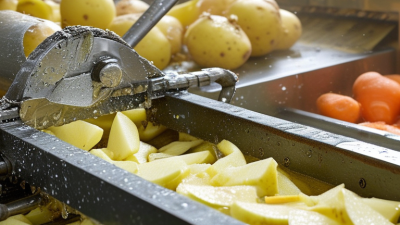
Knife peelers use a blade to remove a controlled layer of skin from each item. In well-adjusted equipment, the blade follows the product’s surface instead of stripping away a thick, uniform band. That can reduce edible loss while producing a consistent finish. A peeled potato, for example, should retain its rounded shape, with little flesh caught in the peelings.
Blade depth, feed speed, and product size all affect results. Operators can inspect samples during a run and adjust settings when peel thickness changes. Small sentence. Sharp blades help maintain clean cuts, while worn edges may leave rough patches or increase waste.
Still, this method is not foolproof. Deep eyes, irregular shapes, and soft spots can challenge even a carefully set machine. For processors, routine checks of blade condition and peeled-product samples are practical ways to catch problems early. Knife peelers suit operations that value controlled cutting, but the best settings depend on the crop and its condition.
Caustic Peelers: 5–20% Sodium Hydroxide and Heat-Based Processing
Caustic peelers loosen skins with heated sodium hydroxide, often using a 5–20% solution.
That range is not a universal recipe. Fellows’ Food Processing Technology (4th edition, 2017) describes lye-peeling performance as dependent on concentration, temperature, and contact time. Operators therefore tune the bath to the crop and its maturity. A potato batch may need different settings from a batch of peaches. Too little treatment leaves stubborn patches; too much can soften the surface and waste edible flesh. Watch the peel closely.
A typical system moves produce through a controlled bath, then removes loosened skins with sprays or mechanical agitation. Temperature sensors and timed conveyance help keep exposure consistent, while routine checks can catch changes in solution strength. The details matter. The NIOSH Pocket Guide to Chemical Hazards lists a 2 mg/m³ ceiling recommended exposure limit for sodium hydroxide.
That figure underscores the need to control mist and protect workers around tanks and rinse stations. Rinse-water management also deserves attention: residual alkali can affect wastewater conditions. In practice, small differences in crop size or bath condition may still produce uneven peeling, and that is worth admitting.
Flame Peelers: High-Temperature Surface Treatment for Peppers and Produce
Flame peelers use direct, controlled heat to loosen skins from peppers and selected produce. A conveyor carries each piece past burners, or a rotating drum tumbles it through a heated zone. The surface chars or blisters while the flesh stays largely intact. Heat does the work. The softened skin is then removed with brushes, air, or water sprays.
For peppers, operators watch for blistering across the curves and folds. Uneven sizes can leave pale patches beside blackened spots, so feed rate and flame exposure need adjustment. Too little heat makes peeling laborious; too much can cook the flesh or reduce yield. Small test runs help reveal how a particular harvest responds. That sounds simple. It isn’t always.
Flame systems can process product continuously and avoid chemical peeling agents, but they still need careful monitoring and cleaning. Burner distance, airflow, and product moisture all affect results. Staff should inspect peeled samples for remaining skin and flesh damage, not rely on surface color alone. There is no perfect setting for every batch; even experienced operators may need to recalibrate when pepper thickness or ripeness changes.