What Are the Top 10 Types of Cooling Equipment?
Cooling Equipment quietly shapes modern life, from supermarket aisles to hospital rooms and server halls. It controls temperature, humidity, air movement, and product safety. Yet the phrase covers very different machines. A household split system cannot replace an industrial chiller, just as a cooling tower cannot serve a small office alone.
Willis H. Carrier, widely recognized as the father of modern air conditioning, wrote, “I conceived the idea of treating air and developed the first air conditioner.” His statement reflects a broader engineering lesson: effective cooling means treating conditions, not merely producing cold air. This guide examines ten major types of Cooling Equipment, including air conditioners, chillers, cooling towers, evaporative coolers, refrigeration systems, heat exchangers, condensing units, cooling coils, industrial fans, and data-center cooling systems.
The categories overlap. That is normal.
Each system moves heat through a different combination of compressors, refrigerants, water, air, pumps, fans, or thermal surfaces. Selecting the right equipment requires more than comparing capacity labels. Engineers usually consider climate, heat load, humidity, operating hours, maintenance access, energy use, noise, and installation space. Safety standards and manufacturer instructions also matter.
Real-world experience complicates tidy rankings. A compact evaporative cooler may perform brilliantly in a dry warehouse but disappoint in humid weather. A high-efficiency chiller may reduce energy costs while demanding skilled maintenance. This article therefore compares practical strengths, limitations, applications, and operating concerns. No list is perfect. Still, it offers a reliable starting point for understanding where each cooling technology fits.
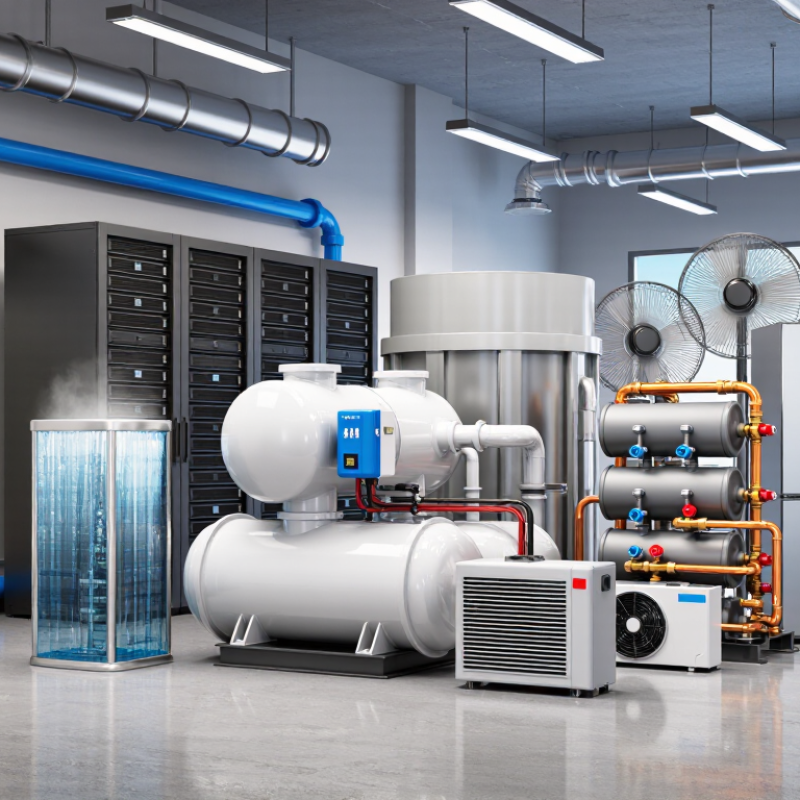
Cooling Equipment: Definition, Purpose, and Operating Principles
Cooling equipment removes heat from a space, process, or product and transfers it elsewhere. Its purpose is not simply to make air feel cold. It also helps control humidity, protect stored goods, and keep machinery within safe operating temperatures. Common systems include air conditioners, chillers, cooling towers, and heat pumps. Each suits different loads and settings.
Most cooling systems move heat through a refrigerant cycle. The refrigerant absorbs heat in an evaporator, then a compressor raises its pressure and temperature. At the condenser, heat leaves the system, often through outdoor air or water. An expansion device then lowers the refrigerant pressure, and the cycle repeats. You can feel this transfer near an outdoor unit: warm air blows across its coil. A cooling tower works differently, using evaporation to reject heat from circulating water. The International Energy Agency’s 2018 report, The Future of Cooling, estimated that global energy demand for space cooling could rise from about 2,000 terawatt-hours in 2016 to 6,200 by 2050. That projection makes efficiency and correct sizing important, though real performance depends on climate, maintenance, and use. Oversized equipment can cycle too often. It may cool quickly, yet control humidity poorly—a detail that is easy to miss.
How Cooling Systems Are Classified by Technology and Application
What Are the Top 10 Types of Cooling Equipment?
How Cooling Systems Are Classified by Technology and Application
Cooling equipment is easier to compare when classified by how it moves heat and where it operates. The main technologies include vapor-compression chillers, absorption chillers, evaporative coolers, cooling towers, air conditioners, heat pumps, fan-coil units, rooftop units, refrigerated display cases, and data-center cooling systems. These categories overlap: a chiller may serve a hospital, factory, or office, while its cooling tower rejects heat outdoors. The labels are useful, but they do not always describe a complete system.
Application shapes the practical choice. A split air conditioner cools a few rooms; a central chiller can serve an entire building. Evaporative cooling uses water evaporation, so it performs differently in humid climates. Refrigerated cases preserve food, while precision systems manage heat from dense server racks. The International Energy Agency’s 2018 report, The Future of Cooling, projected that global energy demand for space cooling could more than triple by 2050. That makes efficiency and operating conditions important, not just equipment type. The UNEP-led Global Cooling Watch 2023 report likewise found that cooling demand could more than triple by 2050 without stronger efficiency measures. Real sites complicate the neat categories: maintenance, humidity, and peak temperatures can change performance. A system that looks efficient on paper may struggle on a hot afternoon.
What Are the Top 10 Types of Cooling Equipment?
Cooling systems are commonly classified by their cooling technology, heat-rejection method, and application. The chart compares representative nominal cooling capacities for ten widely used equipment types.
Capacity figures are representative design values for typical applications. Actual capacity depends on operating conditions, refrigerant, ambient temperature, load profile, and system configuration.
The Ten Main Types of Cooling Equipment and Their Uses
Cooling equipment serves different spaces and loads. Air conditioners cool homes, offices, and small commercial rooms by moving heat outdoors. Chillers remove heat from water, which can then cool large buildings or industrial processes. Cooling towers reject heat from circulating water, often alongside chillers in factories and central plant rooms. Evaporative coolers use water evaporation to lower air temperature; they work best in dry climates and need regular water and pad maintenance. Refrigeration units keep food, medicines, and other temperature-sensitive goods cold in shops, kitchens, and storage areas.
Heat exchangers transfer heat between separate fluids, supporting process cooling without mixing them. Fans move air across people, equipment, or coils, but they do not lower room temperature on their own. Ventilation systems replace stale indoor air with outdoor air and may include cooling coils for comfort. Radiant cooling panels absorb heat from room surfaces and occupants, often in quiet offices; humidity control matters because condensation can form. Ice-storage systems freeze water during off-peak hours and use the stored cooling later, reducing daytime chiller demand. A detail people sometimes overlook: no single type fits every building. Choosing equipment without checking climate, heat load, maintenance access, and operating hours can lead to poor comfort or wasted energy. Even a sound design needs adjustment after real use.
What Are the Top 10 Types of Cooling Equipment? — The Ten Main Types of Cooling Equipment and Their Uses
| No. | Type of Cooling Equipment | How It Works | Common Uses | Key Consideration |
| 1 | Air Conditioner | Moves heat from indoor air to the outdoors using a refrigeration cycle. | Homes, offices, shops, and other occupied indoor spaces. | Cooling capacity should suit the room size, climate, and building heat load. |
| 2 | Chiller | Removes heat from water or another circulating fluid, which is then sent to cooling coils or process equipment. | Large buildings, hospitals, data centers, and industrial processes. | Requires a distribution system; heat may be rejected through air-cooled or water-cooled equipment. |
| 3 | Cooling Tower | Rejects heat from water to the atmosphere, mainly through evaporation and air movement. | Heat rejection for water-cooled chillers and industrial cooling systems. | Uses water and needs appropriate water treatment and routine maintenance. |
| 4 | Evaporative Cooler | Uses water evaporation to cool air; it is most effective when the incoming air is dry. | Workshops, warehouses, and other spaces in hot, low-humidity climates. | Cooling performance decreases as humidity rises, and the system needs a water supply. |
| 5 | Refrigerator | Uses a refrigeration cycle to remove heat from an insulated cabinet. | Food and beverage storage in homes, kitchens, shops, and laboratories. | Different contents require suitable temperature settings and adequate airflow inside the cabinet. |
| 6 | Freezer | Uses a refrigeration system to maintain temperatures below the freezing point of water. | Longer-term storage of frozen food, samples, and temperature-sensitive materials. | Temperature stability and correct storage practices are important for protecting contents. |
| 7 | Heat Pump | Transfers heat between indoors and outdoors; in cooling mode, it moves indoor heat outside. | Residential and commercial spaces that need both heating and cooling. | Seasonal performance depends on equipment design, installation, and outdoor conditions. |
| 8 | Precision Air-Cooling Unit | Controls temperature and, in many designs, humidity and airflow within close operating ranges. | Data centers, telecommunications rooms, and technical facilities. | System design should account for equipment heat loads, airflow paths, and redundancy needs. |
| 9 | Liquid-Cooling System | Circulates coolant through cold plates, coils, or heat exchangers to carry heat away from equipment. | High-performance computing, industrial machinery, and other concentrated heat sources. | Requires compatible components, leak management, and planned coolant maintenance. |
| 10 | Thermoelectric Cooler | Uses an electric current across semiconductor elements to transfer heat from one side to the other. | Small enclosures, portable coolers, and localized electronic or instrument cooling. | Typically suited to compact applications; the hot side must be able to dissipate heat effectively. |
Key Performance Factors: Capacity, Efficiency, and Maintenance
What Are the Top 10 Types of Cooling Equipment?
Key Performance Factors: Capacity, Efficiency, and Maintenance
Cooling equipment includes window units, split systems, packaged rooftop units, chillers, evaporative coolers, cooling towers, heat pumps, portable air conditioners, refrigeration systems, and precision cooling units. Each serves different spaces and loads. A small office may need a split system, while a large building often relies on chillers and air handlers. Match capacity to the actual heat load, not just floor area. Sunlight, occupancy, cooking equipment, and insulation all affect demand. Oversized equipment can cycle too often and leave rooms clammy. Undersized systems may run all day without reaching the set temperature.
Efficiency deserves a closer look. Compare seasonal performance ratings under similar operating conditions, and consider fan and pump energy too. A highly rated unit still wastes power if filters are clogged or controls are poorly set.
Small details matter. Maintenance needs differ: cooling towers require water treatment and inspection, while air conditioners need clean filters and clear condensate drains.
For chillers, technicians should track operating temperatures, pressure, and unusual vibration. Keep service records. They reveal gradual changes that a single inspection can miss.
Capacity calculations also have assumptions; real rooms rarely behave like neat models. That uncertainty is worth checking before purchase.