
China’s formwork industry serves a demanding construction market, where repeat use, dimensional stability, and concrete surface quality directly affect project costs. The National Bureau of Statistics of China regularly identifies construction as a major industrial sector, while Global Market Insights’ Formwork Market Report describes Asia-Pacific as a leading regional growth area. These signals explain the attention surrounding Chinese panel manufacturers.
This article introduces China’s top 10 Solid 27mm 3 Layer Yellow Formwork panel suppliers. The evaluation considers panel thickness, three-layer construction, film quality, bonding performance, edge sealing, supplier experience, and export reliability. Practical details matter. A 27mm panel must resist bending across wall supports, while its yellow surface should remain reasonably smooth after repeated pours. Factory inspection also examines delamination, core gaps, warped edges, and moisture variation.
No ranking is perfect.
Product data can change.
The review refers to supplier specifications, factory evidence, customer feedback, and recognized plywood guidance, including GB/T 17656 and relevant EN 13986 performance principles. These references help separate measurable quality from attractive catalog language. The APA Engineered Wood Handbook also emphasizes moisture control, bonding, and panel handling as important factors in service life.
A yellow film alone proves little. It may look bright in photographs but perform poorly after several concrete cycles. This guide therefore avoids treating price as the main decision factor. It also acknowledges a limitation: publicly available factory information is uneven, and some suppliers disclose more technical data than others. Buyers should verify test reports, sample dimensions, glue type, film weight, and production dates before ordering. That caution is practical, not pessimistic. It protects contractors from choosing a panel that appears strong but fails on site.
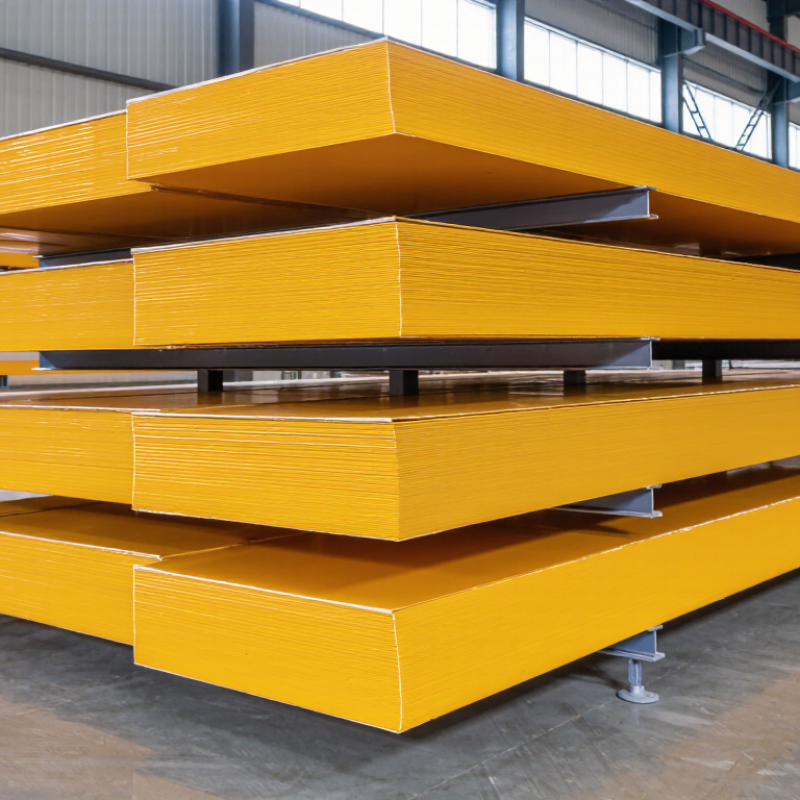
Solid 27mm three-layer yellow formwork panels are engineered plywood sheets for repeated concrete casting. “Three-layer” describes three cross-bonded veneer layers, not one thick timber board. The yellow surface usually comes from a waterproof phenolic film, which limits moisture absorption and helps concrete release cleanly.
Their 27mm thickness provides useful stiffness for slabs, walls, and vertical supports. However, panel performance depends on veneer quality, glue bonding, surface sealing, and edge protection. EN 13986 links wood-based panels with construction performance requirements, while EN 314-2 Class 3 bonding is commonly referenced for exterior exposure. Actual bending strength and deflection should come from the supplier’s test report, not a sales claim.
The detail matters.
FAO’s Global Forest Products Facts and Figures 2023 reported approximately 378 million cubic metres of wood-based panels produced worldwide in 2022. That scale shows the material’s industrial importance, but it does not guarantee equal formwork quality.
Contractors should inspect panel flatness, film adhesion, core gaps, screw holding, and moisture content before installation. A practical check is simple: examine cut edges, tap suspicious areas, and compare measured thickness with the stated 27mm specification. Reuse depends on cleaning, careful stripping, supported storage, and avoiding impact damage. Some product descriptions promise high reuse counts, yet loading conditions and workmanship often matter more than the number printed on a brochure.

Manufacturing three-layer yellow formwork panels in China begins with veneer preparation. Logs are peeled into thin sheets, then dried in controlled chambers. Moisture content matters because wet cores can warp during pressing. Technicians usually inspect each veneer for cracks, knots, and uneven thickness. Weak sheets are removed.
The three layers are arranged with crossing grain directions. This structure improves stiffness and reduces splitting around fasteners. Waterproof adhesive is spread evenly between the veneers. The assembled stack enters a hot press under controlled pressure and temperature. Pressing time depends on wood moisture, adhesive type, and panel thickness. For a 27mm panel, inaccurate pressure can create internal gaps. That defect may remain invisible until concrete loading.
After pressing, the panel is trimmed and sanded. Edges are sealed to limit moisture entry. A yellow surface coating or film is then applied for smoother concrete release and easier cleaning. Quality staff check thickness at several points, not only at the center. They also test bonding, surface flatness, screw holding, and water resistance. Not every panel leaves the press perfectly flat. Production teams sometimes need to adjust veneer grading or pressing cycles. That practical weakness should be recorded, not hidden. Reliable factories keep batch records, sample panels, and inspection results for traceability. Experienced buyers should request these details before approving repeated orders.
What Defines the Top 10 Chinese Formwork Panel Suppliers?
A credible top-ten list should measure performance, not search visibility. China’s construction industry recorded 31.59 trillion yuan in output value in 2023, according to the National Bureau of Statistics. Demand is substantial, but scale alone does not prove panel quality. FAO Forestry Production and Trade data also place China among the world’s leading plywood producers, with annual output exceeding 200 million cubic metres. That capacity creates choices, and confusion.
For 27mm, three-layer yellow formwork panels, buyers should verify thickness tolerance, core density, bonding strength, water resistance, and reuse performance. Independent testing against EN 314-2 or comparable standards gives stronger evidence than catalogue claims. The yellow surface should also be checked for coating weight, edge sealing, and concrete-release behavior after repeated pours. A serious supplier provides batch reports, moisture readings, production dates, and traceable samples. It should explain whether “solid” means full-core construction or simply a marketing description.
Site experience matters. Inspect the panel edges, press one sample, and record warping after wet exposure. Small defects become visible during stripping. The ranking is not permanent. One supplier may perform well in dry climates but poorly under high humidity. That weakness deserves attention. A fair top-ten selection should combine laboratory results, contractor feedback, delivery consistency, complaint records, and transparent factory audits. Price remains relevant, but the cheapest panel can become expensive after early delamination or excessive replacement.
Comparing ten solid 27mm, three-layer yellow formwork panels requires more than checking color. Yellow film can improve concrete release, but it does not prove core strength. I inspect veneer gaps, edge sealing, surface flatness, and screw holding. The strongest panels usually show balanced layers and minimal core voids. A 27mm panel should also resist bending under fresh concrete pressure. Deflection data matters more than attractive packaging.
The USDA Forest Products Laboratory’s Wood Handbook (2021) notes that wood products commonly reach about 6–14% moisture content, depending on climate and exposure. That range explains why poorly sealed edges may swell quickly on wet sites. EN 314-2 Class 3 bonding is a useful reference for humid or exterior conditions. Still, test results can vary between production batches. I would not treat one laboratory sheet as absolute proof. Field handling, storage, and cleaning often change panel life. In practical comparisons, look for stable dimensions, clean concrete faces, and consistent reuse performance.
Tips: Ask for bending, moisture, bonding, and reuse-cycle records. Store panels flat, above standing water, and seal cut edges immediately. Small defects become expensive during repeated pours. The lowest price may hide weaker veneers or faster surface wear.
Choosing solid 27mm, three-layer yellow formwork panels requires more than checking color and thickness. Inspect the core, surface film, edge sealing, and flatness. A reliable panel should have tight layers, clean edges, and no open voids. Place a straightedge across the surface. Small waves may cause visible concrete marks and uneven joints. Confirm the stated thickness with a caliper, because tolerances differ between suppliers. Check moisture resistance through technical documents, not attractive photographs.
During use, support the panels evenly and keep spacing consistent. Poor support can cause deflection, even when the board feels strong. Seal cut edges before placing the panel near wet concrete. Use clean release agent in a thin layer. Too much oil can stain the concrete surface. Tighten joints carefully, but avoid crushing the edges. After stripping, remove concrete residue with a plastic scraper. Metal tools may damage the film. Store panels flat, raised from the ground, and protected from rain. Do not drag them across rough floors.
Tips: Mark each panel after use and record its condition. Rotate panels between high-visibility and less demanding areas. Replace warped or delaminated sheets early. This seems wasteful, but failed panels cost more during a pour. A perfect reuse plan is unrealistic. Weather, handling, and rushed installation always affect performance. Buyers should request sample panels, test them on a small section, and compare results with project requirements. past performance matters, but site conditions can still change the outcome.
The profiles below represent commonly specified 27 mm, three-layer, yellow film-faced plywood configurations for concrete formwork. Values are typical market specifications rather than company or brand claims. Buyers should confirm test reports, tolerances, bonding quality, and actual sample performance before ordering.
| No. | Panel Profile | Typical Sheet Size | Nominal Thickness | Layer Structure | Yellow Film Weight | Core Material | Bonding Grade | Typical Density | Recommended Use | Expected Reuse* | Buyer Selection Check |
|---|---|---|---|---|---|---|---|---|---|---|---|
| 1 | Standard balanced panel | 1220 × 2440 mm | 27 mm | 3 plywood layers | 120–180 g/m² | Mixed hardwood | Exterior-grade phenolic | 580–680 kg/m³ | General wall and slab formwork | 6–10 pours | Check thickness tolerance, flatness, and edge sealing. |
| 2 | High-density hardwood panel | 1220 × 2440 mm | 27 mm | 3 plywood layers | 180–220 g/m² | Hardwood veneer | Exterior-grade phenolic | 650–750 kg/m³ | High-pressure columns and walls | 8–15 pours | Request density records and bonding inspection results. |
| 3 | Large-format wall panel | 1500 × 3000 mm | 27 mm | 3 plywood layers | 180–220 g/m² | Poplar-hardwood composite | Exterior-grade phenolic | 560–650 kg/m³ | Large wall areas with fewer joints | 5–10 pours | Verify lifting method, support spacing, and panel deflection. |
| 4 | Smooth-finish concrete panel | 1250 × 2500 mm | 27 mm | 3 plywood layers | 220–240 g/m² | Selected hardwood veneer | Exterior-grade phenolic | 620–720 kg/m³ | Architectural fair-faced concrete | 8–12 pours | Inspect film uniformity, pinholes, and surface gloss consistency. |
| 5 | Moisture-resistant slab panel | 1220 × 2440 mm | 27 mm | 3 plywood layers | 180–220 g/m² | Hardwood or eucalyptus veneer | Exterior-grade phenolic | 600–700 kg/m³ | Floor slabs and repetitive pours | 8–14 pours | Use boiling-water resistance or equivalent bond test data. |
| 6 | Cut-to-size modular panel | Custom; commonly 610–1220 mm wide | 27 mm | 3 plywood layers | 120–180 g/m² | Mixed hardwood | Exterior-grade phenolic | 580–680 kg/m³ | Small modules, beams, and infill zones | 5–10 pours | Confirm cut-edge sealing and dimensional accuracy after machining. |
| 7 | Cold-weather construction panel | 1220 × 2440 mm | 27 mm | 3 plywood layers | 180–220 g/m² | Dense hardwood veneer | Exterior-grade phenolic | 620–720 kg/m³ | Winter concreting and damp conditions | 6–12 pours | Check adhesive performance, moisture content, and storage protection. |
| 8 | High-cycle reusable panel | 1220 × 2440 mm | 27 mm | 3 plywood layers | 220–240 g/m² | Hardwood veneer | Exterior-grade phenolic | 650–750 kg/m³ | Projects with repeated standard dimensions | 10–18 pours | Assess edge durability, screw-holding capacity, and repairability. |
| 9 | Economy general-purpose panel | 1220 × 2440 mm | 27 mm | 3 plywood layers | 120–160 g/m² | Poplar or mixed hardwood | Exterior-grade phenolic | 520–620 kg/m³ | Short-duration foundations and temporary works | 3–6 pours | Compare total cost per pour, not only purchase price. |
| 10 | Heavy-duty engineered panel | 1500 × 3000 mm | 27 mm | 3 plywood layers | 220–240 g/m² | High-density hardwood | Exterior-grade phenolic | 680–780 kg/m³ | Heavy wall systems and demanding formwork | 10–16 pours | Verify structural calculations, panel stiffness, and handling equipment. |
*Reuse figures depend on concrete pressure, support spacing, release agent, cleaning method, edge sealing, weather exposure, and storage. Apply release agent before each pour, seal all cut edges, clean without scraping the film, and store panels flat on raised supports under cover.
JK Machinery a.s.
Psohlavců 322/4, Praha 4,
Czechia
T: +420 777 610 380
E: sale@roll-formingmachinery.com