Choosing a marine explosion proof light is not only about brightness. Salt spray, vibration, moisture, and temperature changes can challenge a fixture throughout its service life. A dependable choice should suit the vessel, mounting position, and operating conditions. It should also provide clear product documentation for its hazardous-area rating and marine suitability. Details matter.
This guide compares ten options through practical buyer considerations, including light output, beam spread, housing materials, sealing, power needs, and installation requirements. A deck light may need a broad, even beam, while a compact fixture near machinery may call for a different design. Stainless steel or corrosion-resistant aluminum can help withstand harsh environments, but the exact material and finish still deserve close inspection. Check the stated ingress protection, operating temperature, and approved location against the product datasheet. Do not rely on a product name alone.
The strongest option is not automatically the brightest or most expensive. Verify that its certification matches the intended installation, and consult a qualified marine electrician when wiring or hazardous-area classification is unclear. Compare warranty terms, replacement parts, and the manufacturer’s support as carefully as headline specifications. Small errors matter. Even a well-built fixture can disappoint if its beam, mounting, or rating does not match the job. This selection aims to make those trade-offs easier to assess, while recognizing that no single light is right for every vessel.
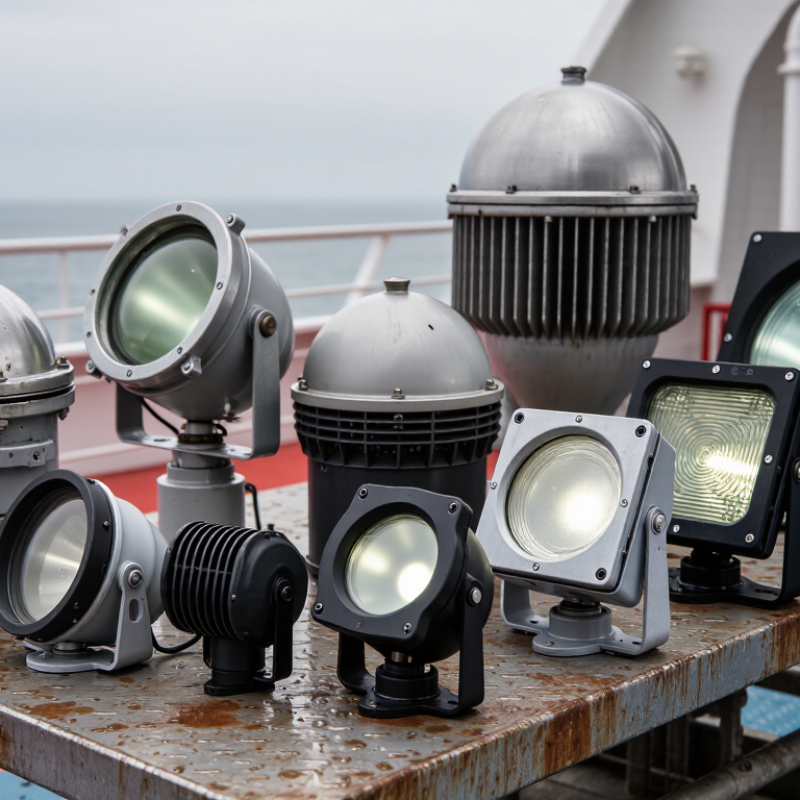
Marine explosion-proof lights are designed to control ignition risk, not to keep every gas molecule outside. In a flameproof design, an internal electrical fault may ignite a hazardous mixture, but the enclosure contains the explosion. Narrow flame paths cool escaping gases before they can ignite the surrounding atmosphere. These paths must stay intact; corrosion, impact damage, or an incorrect repair can compromise protection. Saltwater makes that practical detail hard to ignore.
Temperature matters, too. IEC 60079-0:2017 assigns equipment temperature classes: T4 limits the maximum surface temperature to 135°C, while T6 limits it to 85°C. A lower surface temperature can reduce the chance of igniting certain gases, but the correct class depends on the site’s hazards. IEC 60079-10-1:2020 describes classifying areas by how often explosive gas atmospheres may occur and how long they persist. Buyers should match a light’s protection method, gas group, temperature class, and area classification. An IP rating addresses dust and water ingress; it does not, by itself, establish explosion protection. Easy to overlook. A corroded bracket or damaged cable entry can also undermine an otherwise suitable installation.
Marine explosion-proof lights should be selected by location, not appearance. A bright beam means little if the fixture lacks approval for the hazardous area. Check its marking for the protection concept, gas group, temperature class, and permitted Zone or Division. These details help determine whether the light suits nearby vapors, gases, or combustible dust. Requirements vary by vessel, flag, and operating region, so confirm the applicable IECEx, ATEX, or national certification with a qualified marine electrical professional.
IP ratings describe resistance to water and dust, not protection against ignition. A high IP rating alone does not make a light explosion-proof. Look for corrosion-resistant materials, sealed cable entries, and a stated ambient-temperature range. Salt spray, vibration, and washdown can expose weak points quickly. Check whether the product also carries relevant marine type approval or class acceptance for the vessel. It can be easy to miss that distinction.
Read the full certificate, not just a label or catalog headline. Confirm that the exact model, mounting method, and cable glands match the approved configuration. A temperature rating may change with ambient conditions, and an unsuitable replacement gland can compromise the installation. Keep the paperwork with maintenance records. Even then, ratings do not replace a site assessment; real engine-room conditions can be messier than a specification sheet suggests.
IEC 60529 ingress-protection tests: IPX5 and IPX6
IEC 60529 specifies a nominal flow rate of 12.5 L/min for IPX5 and 100 L/min for IPX6 water-jet tests. An IP rating describes protection against ingress; it does not certify a light for explosive atmospheres. For hazardous marine locations, check the applicable ATEX or IECEx approval, zone, gas group, and temperature class.
A marine explosion-proof light must match the hazard zone, not just the vessel’s layout. Check its certification, gas or dust group, and temperature class against the site assessment. A housing that runs too hot can be unsuitable near combustible vapors. Ask for the certificate and installation limits; a sales sheet alone may leave gaps. Details matter.
Salt spray, vibration, and washdown challenge every fitting. Look for corrosion-resistant materials, sealed cable entries, and an ingress-protection rating suited to the location. Consider beam spread and mounting height, too: a narrow beam may leave dark patches on a wet deck. The Allianz Commercial Safety and Shipping Review 2024 recorded 26 total vessel losses worldwide in 2023, underscoring the continuing importance of onboard risk controls. That figure is not specific to lighting, but it gives useful safety context.
Check whether the light’s approved operating temperature fits the vessel’s actual conditions, including enclosed machinery spaces. Confirm that replacement parts and maintenance instructions are available for the installation. During a survey, inspect seals, fasteners, and cable glands for corrosion or damage. A lamp can look sound and still have a compromised seal. Verify with a qualified marine electrical professional.
Ten Marine Explosion-Proof Lights Compared
Comparing ten marine light designs starts with where each one will be mounted. Compact bulkhead lights suit narrow passageways, while wide-beam ceiling fixtures spread light across work areas. Floodlights reach open decks; linear battens provide even coverage in corridors. Wall-mounted units can brighten equipment panels, and portable hand lamps help with inspections. Recessed fixtures save headroom, high-bay lights serve taller spaces, pendant lights hang over work zones, and emergency units provide backup illumination. Their performance varies with mounting height, beam angle, and enclosure rating.
Compare more than stated light output. Look for corrosion-resistant materials, sealed cable entries, suitable operating temperatures, and accessible maintenance points. On a damp deck, a poorly placed fitting may glare off wet steel instead of lighting a walkway. Emergency models also differ in backup duration and testing features. These ten categories are a useful starting point, not a perfect ranking; actual performance depends on the vessel and installation. Have a qualified marine electrician verify compatibility before selection.
Marine explosion-proof lights need more than a rugged housing. Match the equipment certification to the hazardous-area zone, gas group, temperature class, supply voltage, and ambient conditions. IEC 60079-14 covers the design and installation of electrical equipment in explosive atmospheres. Follow its requirements and the light manufacturer’s instructions. Use certified cable glands, tighten entries correctly, and preserve bonding and grounding. A small gap can defeat protection.
Check the rating against the actual exposure. Under IEC 60529, IP66 means dust-tight protection and resistance to powerful water jets; it does not mean the fixture can be submerged. Salt spray, vibration, and repeated washdowns can still damage seals. The European Maritime Safety Agency’s Annual Overview of Marine Casualties and Incidents 2024 recorded 2,676 marine casualties and incidents in 2023. That figure does not identify lighting as a cause, but it underlines why routine checks matter.
IEC 60079-17 sets inspection and maintenance requirements for hazardous-area installations. Inspect lights at risk-based intervals, and record findings. Look for cracked lenses, corrosion around fasteners, loose glands, damaged cables, and water or condensation inside the housing. A clean lens can still hide a loose entry. Isolate power before opening equipment, and have competent personnel handle repairs. Replace damaged seals with specified parts; improvisation is tempting, but it may compromise the protection. Keep inspection records specific: note the fixture location, defect, action, and date.
JK Machinery a.s.
Psohlavců 322/4, Praha 4,
Czechia
T: +420 777 610 380
E: sale@roll-formingmachinery.com